

RAM Crisis 2025: Why DDR5 Prices Have Tripled in 3 Months (And What You Need to Know)

The Perfect Storm: How AI Created a Memory Apocalypse
You wanted to upgrade your gaming PC with some fresh RAM last month. You checked the prices reasonable. You decided to wait a few weeks. By the time you came back, the same 16GB DDR5 stick had nearly doubled in price. Welcome to 2025’s RAM crisis: the worst memory market crisis in over a decade.
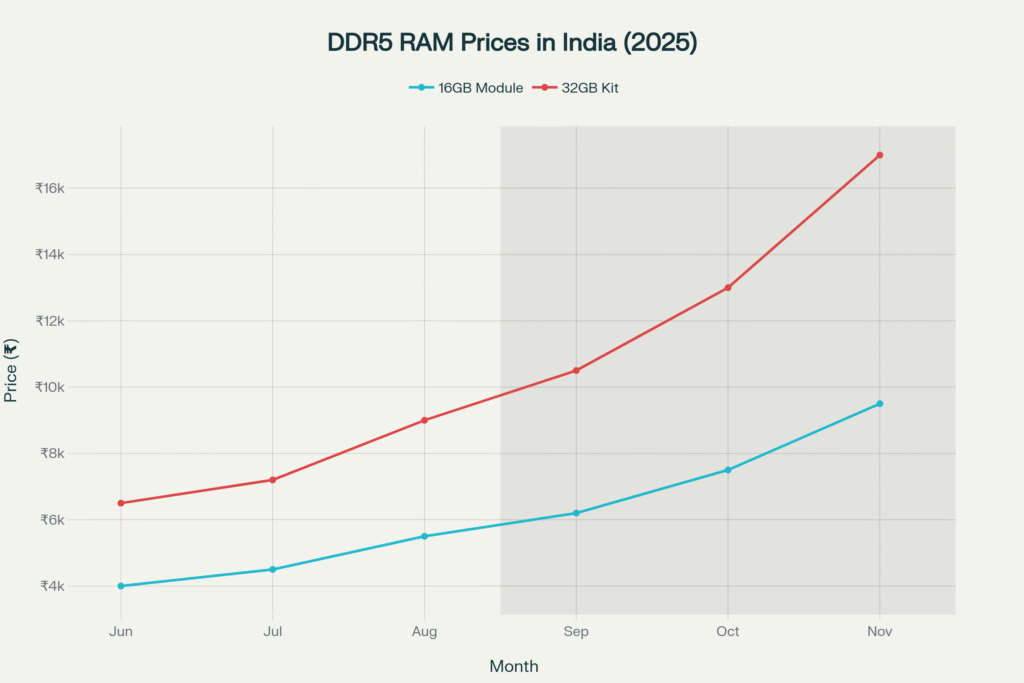
Since September 2025, DDR5 prices have skyrocketed 307%. A 16GB DDR5-5600MHz module that cost ₹4,000 in July now costs anywhere from ₹8,000 to ₹14,000. Some premium 32GB kits have gone from ₹6,500 to over ₹17,000. If you’re in the market for RAM right now, you’re not imagining things the market has genuinely gone insane.
But here’s the million-rupee question: Why? Why, in an age of Moore’s Law and abundant manufacturing capacity, has the price of basic memory tripled faster than we can process it? The answer involves AI, corporate greed, geopolitical tensions, and a supply chain that never saw it coming
The AI Supercycle – The Real Culprit
The primary reason RAM prices have exploded is not new manufacturing constraints or natural resource scarcity. It’s artificial intelligence and the global race to build it.
The AI Data Center Boom
In 2024-2025, every major tech company on Earth suddenly decided that AI infrastructure was essential. Microsoft, Google, Amazon, Meta, and countless enterprises started building massive data centers to train and run large language models, image generators, and AI services.
These data centers don’t just need lots of RAM they need insane amounts of it. A single GPU server for AI inference might require 256GB to 512GB of high-bandwidth memory. Enterprise customers aren’t buying single sticks; they’re ordering millions of modules at a time.
Memory Has Become a Scarce Resource
Here’s where it gets critical: the fabrication plants (fabs) that manufacture DRAM chips aren’t unlimited. There are only three major memory manufacturers globally: Samsung, SK Hynix, and Micron Technology (plus China’s CXMT, which is much smaller). These companies control roughly 95% of the global DRAM market.
In 2025, these manufacturers had a choice: continue making memory for consumer PCs, or shift production to the lucrative AI server market, where a single contract can be worth billions. Guess what they chose?
SK Hynix announced it has sold out its entire 2025 supply to enterprise customers.
Samsung increased DDR5 prices by 60% between September and November 2025 alone. Micron stated that supply would remain tight well into 2026.
Meanwhile, consumer demand didn’t decrease. Everyone still wants to upgrade. But with 70% of manufacturing capacity now dedicated to AI servers, consumer supply collapsed and prices skyrocketed to astronomical levels.
The Three-Part Price Explosion
To understand just how severe this crisis is, let’s break down the price increases across different types of memory:
DDR5: The Mainstream Victim
DDR5 is the newest memory standard. It’s what you need for modern Intel Core Ultra (15th gen), AMD Ryzen 7 (9th gen), and any AM5 motherboard released in the last two years.
The Price Increases:
| Capacity | June 2025 Price | November 2025 Price | Price Increase |
|---|---|---|---|
| 16GB DDR5-5600 | ₹4,000 | ₹8,000-₹10,000 | +150-250% |
| 32GB DDR5 Kit (2x16GB) | ₹6,500 | ₹14,000-₹17,000 | +170-261% |
| 16GB DDR5 (Spot Market) | $7.68 (≈₹640) | $15.50 (≈₹1,290) | +102% in one month |
Even more alarming: contract prices for 32GB DDR5 modules jumped from $149 in September to $239 in November a 60% increase in just two months.
DDR4: The Forgotten Legacy Standard Gets Squeezed
Now here’s something bizarre: DDR4 is older, cheaper to manufacture, and being phased out. Yet its prices have also tripled.
Why? Because manufacturers are shutting down DDR4 production lines to make room for DDR5 and HBM (High Bandwidth Memory). This creates artificial scarcity. In some markets, DDR4 now costs MORE per unit than DDR5 an unprecedented price inversion.
For anyone trying to budget-upgrade an older Ryzen 3000/5000 or Intel 10th-gen system, this is a nightmare. You’re being forced to upgrade your platform just because legacy parts are now extinct.
The Ripple Effect: SSDs and GPUs
It’s not just RAM. The NAND flash memory used in SSDs has also surged. Enterprise customers buying for AI data centers are hoarding both DDR5 and enterprise-grade SSDs, reducing consumer supply.
SSD prices have jumped 100% in some cases. A 1TB NVMe that cost ₹4,000 now costs ₹8,000-₹14,000.
Even worse: Nvidia and AMD are considering price increases on GPUs to compensate for rising memory costs (every GPU includes VRAM). We may see RTX 5090 prices (if they ever arrive) spike by another 10-15%.
Why Can’t Manufacturers Just Build More Capacity?
A reasonable question: if there’s such high demand, why don’t Samsung and SK Hynix just build more fabs?
The answer reveals how trapped the industry really is.
Building a Fab Takes Years and Billions
A single advanced DRAM fabrication plant costs $10-20 billion to build and requires 3-5 years to construct and validate. Even if Samsung announced a new fab today, it wouldn’t be operational until 2028-2029.
Intel, TSMC, and Samsung are all investing in expansion, but those facilities won’t come online for years. We’re essentially stuck with current capacity until 2026-2027 at the earliest.
The HBM Complexity
Traditional DDR5 is relatively straightforward to manufacture. But AI servers need HBM (High Bandwidth Memory) a special type of memory that’s stacked vertically for extreme speeds. HBM is exponentially harder to produce, yields are lower, and it requires completely different manufacturing processes.
SK Hynix is now allocating fab capacity to produce 8x more HBM4E by 2026 this means even less consumer DDR5 coming to market.
The China Factor
China’s government has mandated that CXMT (the country’s main memory maker) shift production toward DDR5 and reduce DDR4 output. This was done to reduce dependence on Western technology and achieve semiconductor self-sufficiency.
The side effect? Global DDR4 supply dropped off a cliff in mid-2025.
Real-World Impact in India
India hasn’t been spared. In fact, Indian PC builders are getting hit harder than Western markets because:
Import duties: India has tariffs on memory imports, making international alternatives expensive
Limited local manufacturing: India doesn’t have DRAM fabs, so all memory is imported
Retailer stockpiling: Indian retailers might have stockpiled inventory at inflated prices, expecting further increases
Currency fluctuations: The rupee has weakened, making imports even more expensive
Current India Pricing (November 2025):
Corsair Vengeance DDR5 16GB: ₹16,600-₹17,100 (was ₹7,000-₹9,000 in June)
Adata XPG Lancer DDR5 16GB: ₹9,600-₹12,100 (was ₹4,500-₹6,000 in June)
32GB DDR5 Kits: ₹25,000-₹35,000 (was ₹10,000-₹14,000 in June)
Premium Corsair RGB DDR5 32GB: ₹31,000-₹35,000 (down from ₹49,000, but still 3x higher than mid-2024)
If you’re building a PC in India right now, memory alone can add ₹8,000-₹15,000 to your budget compared to just six months ago.
How Long Will This Last? The Bleak 2026 Forecast
This is where things get really grim. Industry experts aren’t predicting relief anytime soon.
The 2026 Outlook: Buckle Up
According to TrendForce and DigiTimes (major market research firms):
Q4 2025 – Q2 2026: Prices Will Likely INCREASE further, not decrease.
Quarterly price hikes: 30-50% per quarter through Q2 2026
16GB DDR5 target price: ~$30 by mid-2026 (up from ~$7.68 in September 2025)
DDR4 shortage: Expected to persist through H1 2026
No meaningful relief: Earliest price stabilization: mid-2026 at best
Why Prices Are Going UP, Not Down
You might think: “If there’s a shortage now, won’t manufacturers ramp production and create a glut, driving prices down?”
Normally, yes. But this time is different because:
Persistent AI demand: Enterprise demand for AI infrastructure won’t cool off in 2026. If anything, it will intensify.
No rapid capacity additions: New fabs won’t be ready until 2027+.
HBM prioritization: Manufacturers are shifting toward HBM for servers, not standard DDR5.
Stockpiling and hoarding: OEMs are buying extra inventory to hedge against shortages, which artificially inflates demand.
Price signaling: By maintaining high prices now, manufacturers ensure OEMs buy only what they need, avoiding inventory collapse when supply eventually recovers.
When Will Prices Actually Drop?
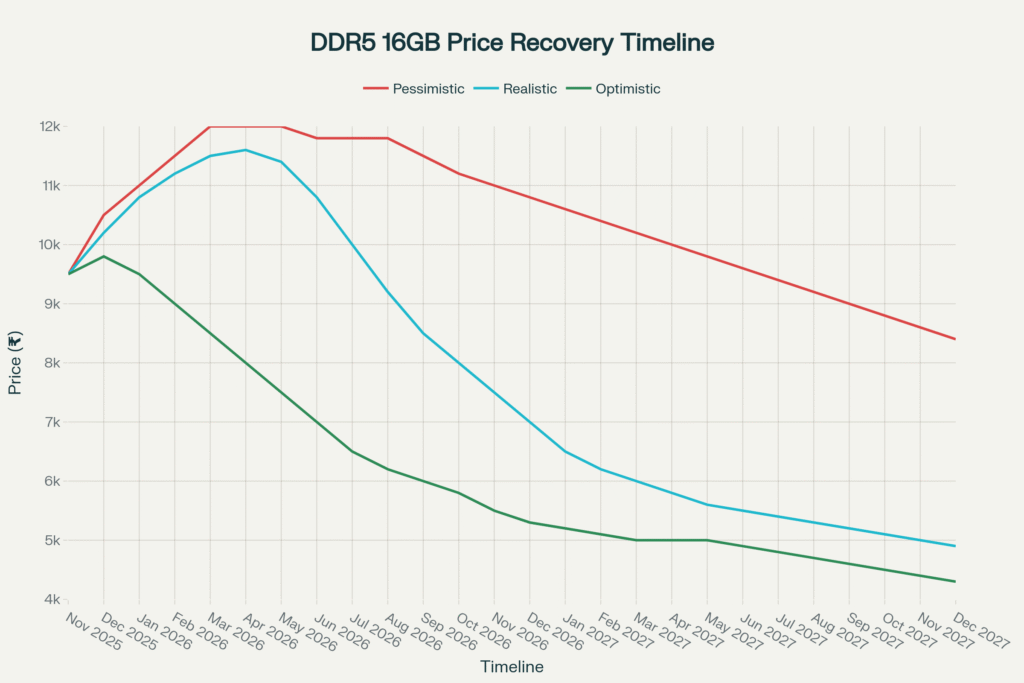
Optimistic scenario: Mid-to-late 2026 (18-24 months from now)
Realistic scenario: Late 2026 or early 2027
Pessimistic scenario: 2027-2028 (if new capacity is delayed)
Team Group, a major memory manufacturer, explicitly stated in October 2025: “The supply-demand imbalance is expected to persist through at least the first half of 2026.”
Even if new fabs come online, the market may not see a major price correction for another 1-2 years minimum.
What You Should Do Right Now
Okay, so prices are terrible and they’ll probably stay terrible for a while. What are your options?
Option 1: Buy Now (If You Need It)
Pros:
Prices might go UP further in Q4 2025 and Q1 2026
Your system will be ready to use now
Some components (like RGB RAM) have sold out completely at certain retailers
Cons:
You’re paying peak prices
Your money could be better spent on other upgrades
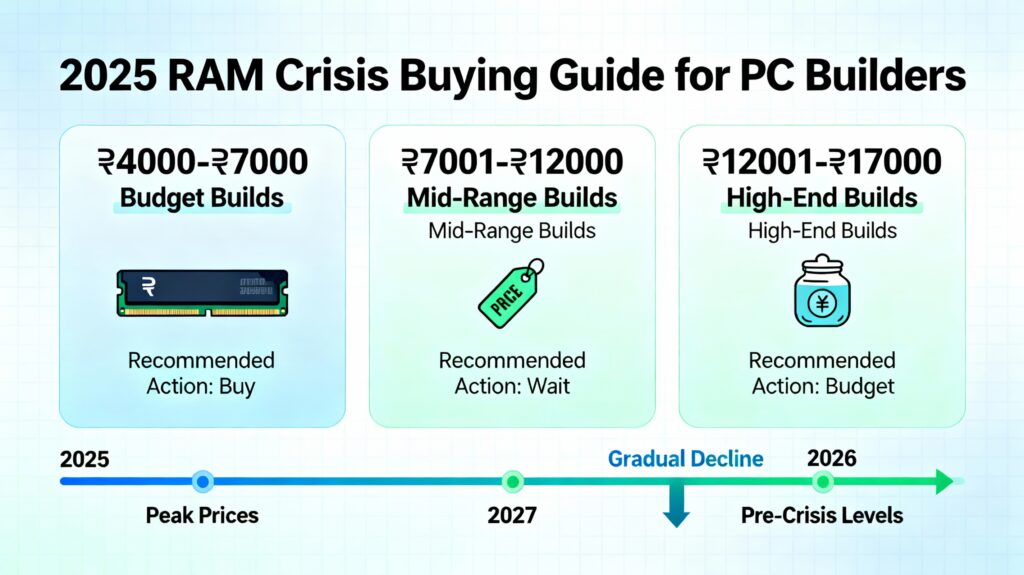
Recommendation: If you’re building a new system and RAM is the only missing piece, buy now. The cost increase from waiting is likely greater than the cost of buying today. However, don’t upgrade RAM in an existing system unless it’s genuinely bottlenecking your performance.
Option 2: Wait and Upgrade Later (If Possible)
Pros:
You avoid peak pricing
You’ll have more options when supply normalizes
Maybe you’ll find better deals on other components in the meantime
Cons:
You might wait 12-24 months
Prices might stay high longer than expected
Your current system might feel sluggish without the upgrade
Recommendation: If your current RAM setup is adequate (16GB for gaming, 32GB for content creation), you can afford to wait. Don’t buy more RAM just because you feel like it the ROI isn’t there.
Option 3: Buy Used/Refurbished RAM
Pros:
10-30% cheaper than retail
Often comes with warranty
Helps reduce e-waste
Cons:
Limited selection
Risk of buying something with a short remaining lifespan
Hard to find current-generation modules
Where to buy:
Amazon Renewed
OLX.in
Local PC shops (they often have returns/repairs)
Recommendation: Viable if you can find authentic refurbished sticks. Just verify the seller reputation carefully.
Option 4: Opt for Budget-Friendly Alternatives
Downgrade to DDR4 (if you’re building a new AM5/DDR5 system):
Many retailers still have old DDR4 stock
Performance difference in gaming: 3-5%
Cost savings: 20-30%
Caveat: DDR4 prices are also high, and future upgrades will be expensive
Choose budget DDR5 brands:
Adata XPG (₹9,600 – ₹12,000): Better value than Corsair
Lexar (if available): Competitive pricing
Avoid:** Premium Corsair RGB (40% price premium over performance)
Recommendation: If you’re building on a tight budget, buy budget DDR5 (Adata) rather than DDR4. You future-proof yourself, and the price difference is smaller than you think.
Option 5: Focus on Other Upgrades
Instead of fighting the RAM market, consider upgrading:
GPU: Prices have stabilized and stock is good
SSD: Still expensive, but performance uplift is real
CPU: Prices are stable and competition is fierce (Intel vs. AMD)
Motherboard/Platform: New AM5 boards offer great value
Recommendation: If your RAM is adequate, invest in a better GPU or CPU first. You’ll see more performance improvement.
The Shocking Price Inversion – DDR4 vs. DDR5
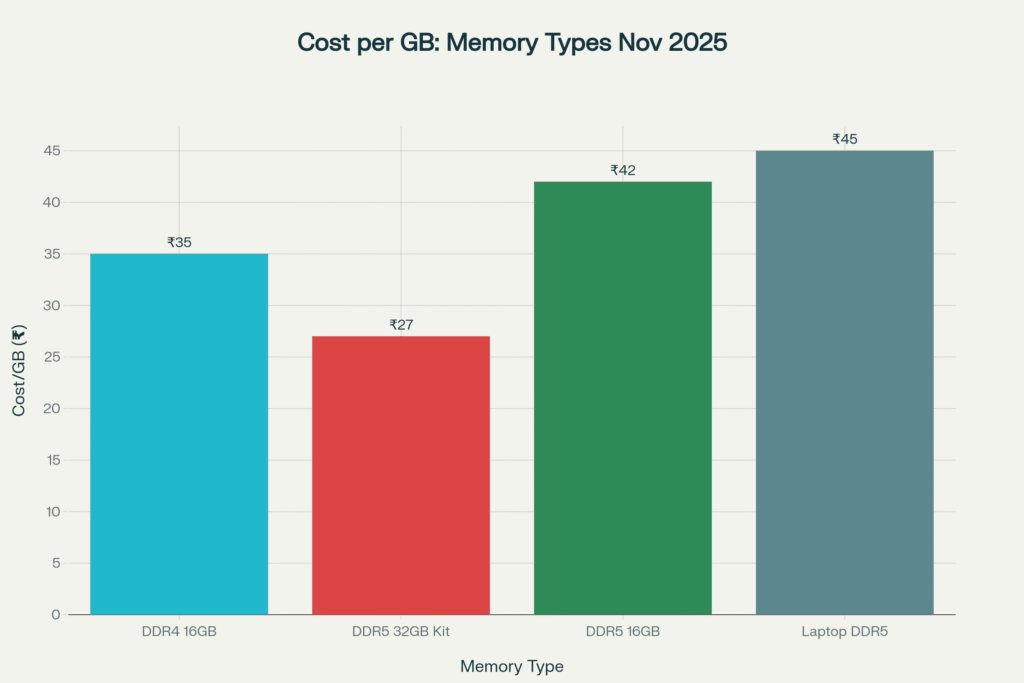
Here’s something that would’ve been impossible two years ago: DDR4 is now more expensive per unit than DDR5.
Cost Per GB Comparison (November 2025):
| Type | Cost Per GB |
|---|---|
| DDR4 (16GB) | ₹32-40 per GB |
| DDR5 (32GB) | ₹25-28 per GB |
Translation: A 32GB DDR5 kit (₹25,000) is actually cheaper per GB than a 16GB DDR4 kit (₹10,000).
This is a sign that DDR4 is being completely phased out. Manufacturers are no longer competing on DDR4 price they’re simply letting it die through artificial scarcity while pushing customers toward DDR5.
Will Made-in-India Semiconductors Help?
Here’s a hopeful ray of light: India is investing heavily in semiconductor manufacturing. By 2028-2030, India could have its own DRAM fabs through partnerships with companies like Micron and others.
But realistically? This won’t solve the immediate crisis. Even when new fabs come online, it takes years to ramp production, achieve yields, and integrate into supply chains.
Timeline:
2025-2026: India’s fabs are still under construction
2027-2028: Pilot production begins
2029-2030: Meaningful volume available
Impact on prices: Potential 10-20% reduction in India-specific pricing by 2030, but global dynamics (AI demand) will still dominate.
The Psychology of Price Panic – Why It’s Getting Worse
One thing making the crisis worse is panic buying and hoarding.
How the Spiral Works:
Prices increase 10%
Consumers and retailers panic-buy to secure inventory
This artificial demand spike creates actual shortage signals
Manufacturers interpret this as “even higher demand,” so they raise prices more
More panic buying
Repeat
This feedback loop has already triggered multiple waves of buying since September 2025:
Japanese retailers started limiting RAM purchases per customer
Framework (laptop company) delisted standalone RAM modules to prevent scalpers
CyberPowerPC announced 500% RAM price increases effective December 7, 2025
Indian retailers are stockpiling before the next predicted price spike in December
What Manufacturers Are Actually Saying
If you want to understand how severe this is, listen to what the industry leaders are saying:
SK Hynix (Oct 2025):
“We have entered an era in which supply is facing a bottleneck. We are receiving memory chip supply requests from many companies, and we are thinking hard about how to address all demands.”
Translation: They literally cannot make enough memory. Demand is unlimited; supply is fixed.
Silicon Motion CEO (Nov 2025):
“We’re facing [what has] never happened before: HDD, DRAM, HBM, NAND… all in severe shortage in 2026.”
Translation: This isn’t just RAM everything is running out.
Counterpoint Research (Nov 2025):
“Global DRAM production is projected to increase by over 20% in 2026, but even that won’t be enough to meet demand growth.”
Translation: Even massive production increases won’t fix the shortage.
The AI Arms Race – Who’s Hoarding Memory?
Understanding why memory is so scarce requires knowing who’s buying it all.
Top Buyers (2025):
Hyperscalers: Google, Microsoft, Amazon, Meta (building data centers)
AI Chip Companies: Nvidia (for demo/test systems)
Enterprise: Every major corporation wants AI capabilities
Cryptocurrency/Mining: Still relevant in some markets
Emerging Markets: Countries like India and Southeast Asia investing in AI infrastructure
Indian examples:
Reliance Jio is building massive data centers and investing $11 billion in AI infrastructure
NM1 (National Data Hub in Mumbai): Contains 70% of India’s AI computing capacity
Government initiatives: PLI 2.0 is incentivizing semiconductor manufacturing
These players are buying in bulk, with contracts lasting years. Once a large buyer locks in supply, consumer market gets crumbs.
The Light at the End of the Tunnel
Okay, so the news is grim. But let’s look at what will eventually fix this:
Long-Term Solutions Already in Motion:
New DRAM Fabs Coming Online (2027-2028):
Intel’s Ohio fab (partially operational)
Samsung’s Texas expansion
SK Hynix’s South Korea upgrades
HBM Production Scaling:
TSMC ramping HBM output
Samsung and SK Hynix investing billions
This will eventually reduce pressure on consumer DDR5
China’s CXMT Catching Up:
Now producing competitive DDR5 at scale
This increases global supply (slight relief)
But subject to US sanctions
AI Boom Moderating:
Eventually, enterprise demand will plateau
Once all the data centers are built, memory demand stabilizes
Estimated timeline: 2027-2028
Made-in-India Capacity:
By 2028-2030, India could produce 10-15% of domestic demand locally
Tariffs and import costs drop
Price relief for Indian consumers
Realistic Timeline to “Normal” Pricing:
Late 2026: Price increases slow (but stay elevated)
Early-Mid 2027: First meaningful price stabilization
2028+: Prices gradually return to “reasonable” levels (probably 30-40% below peak, but still higher than 2023)
Final realistic estimate: Plan for expensive RAM through 2027. Expect prices to start normalizing in 2028.
India-Specific Buying Guide (November 2025)
If you absolutely must buy RAM in India right now, here’s what to buy and where:
Best Value (Budget):
Adata XPG Lancer Blade 32GB (16GBx2) 6000MHz
Price: ₹9,600–₹12,100
Per GB: ₹150-190
Pros: Reliable, decent speed, not RGB (hence cheaper)
Where: Viperpc.in, ComputechStore.in, EliteHubs.com
Best Balanced (Mid-Range):
Corsair Vengeance Non-RGB 32GB (16GBx2) 6000MHz
Price: ₹24,000–₹31,000
Per GB: ₹375-485
Pros: Excellent warranty, reliable brand, good speed
Where: MD Computers, Newegg India, Amazon
Premium (If Budget Is No Object):
Corsair Dominator Platinum RGB 32GB (16GBx2) 6000MHz
Price: ₹34,000–₹40,000
Per GB: ₹530-625
Pros: Best aesthetics, excellent cooling, highest reliability
Where: Official retailers, high-end PC shops
What to AVOID:
Cheapo brands (Storex, Kingmax) – not worth the risk
RGB variants – paying 30-40% more for lights, not performance
32GB+ single sticks – extremely overpriced due to low supply
DDR4 – unless you’re upgrading a legacy system; even then, price is inflated
Pro Tips:
Check multiple retailers: Prices vary wildly (₹2,000-₹5,000 difference)
Look for discounts: Some retailers offer 15-25% off (listed prices, not actual prices)
Negotiate offline: SP Road and Lamington Road might offer 5-10% off if you buy in bulk
Set price alerts: Use PriceHistory.app to track RAM prices
FAQ – Your Burning Questions Answered
Q: Will RAM prices ever go back to 2023 levels?
A: Probably not. Even after the shortage ends, manufacturers have tasted high margins. Expect a “new normal” that’s 30-50% higher than 2023 prices by 2028.
Q: Is it worth upgrading from 16GB to 32GB right now?
A: Only if you’re heavily multitasking, streaming, or content creating. For gaming, 16GB is still adequate. The cost-benefit ratio is terrible right now.
Q: Should I buy DDR4 or wait for cheaper DDR5?
A: Buy DDR5 now if building new. DDR4 pricing is also inflated, and DDR4 is being phased out. Better to pay the price premium once for DDR5 than buy twice.
Q: Will my 2-year-old RAM still be worth buying?
A: No. The shortage is current, not historical. Don’t buy old/used RAM unless it’s a significant discount (40%+).
Q: Can I upgrade my laptop RAM to save money?
A: Some laptops have upgradeable SO-DIMM slots. Laptop RAM is slightly cheaper than desktop RAM (₹2,000-₹3,000 less), so if your laptop supports it, this is a viable option.
Q: Is this shortage affecting India worse than the West?
A: Yes. India has higher tariffs, no local manufacturing, and a smaller market power compared to the US/EU. We’re paying a 15-20% premium compared to global prices.
Q: Should I return my recently purchased RAM if I bought it before prices spiked?
A: No. Resale value is HIGH right now. If you bought 2 months ago, your RAM is now worth 30-40% more. Hold onto it.
Conclusion: The RAM Crisis Is Real, and It’s Here to Stay
The bottom line:
Prices have tripled in 3 months due to AI infrastructure demands hoovering up 70% of DRAM production.
This will persist through 2026 and possibly into 2027. Don’t expect relief soon.
In India, the pain is acute due to tariffs, imports, and limited local alternatives.
For PC builders, the recommendation is simple:
If you need a new system, buy RAM now and accept the cost
If your current system is adequate, wait until 2027
Budget 30-40% more for RAM than you would have in 2023
The silver lining: Eventually (2027-2028), new fab capacity, China’s CXMT scaling, and AI demand moderation will bring prices down. This is temporary, even though it doesn’t feel like it.
The RAM crisis of 2025 will be remembered as the year the PC building hobby became significantly more expensive. But like all market crises, it will pass. In the meantime, pick your battles, buy smart, and don’t panic.
Your wallet will thank you in 2028.
Stay Updated
DDR5 prices change weekly. For the most current pricing, check:
-
PickPCParts.in (obviously!)
Bookmark this post and come back in 6 months. By then, we might have better news or worse news. Either way, at least you’ll understand why.
What’s your experience been? Have you bought RAM recently? Share your horror stories in the comments below!